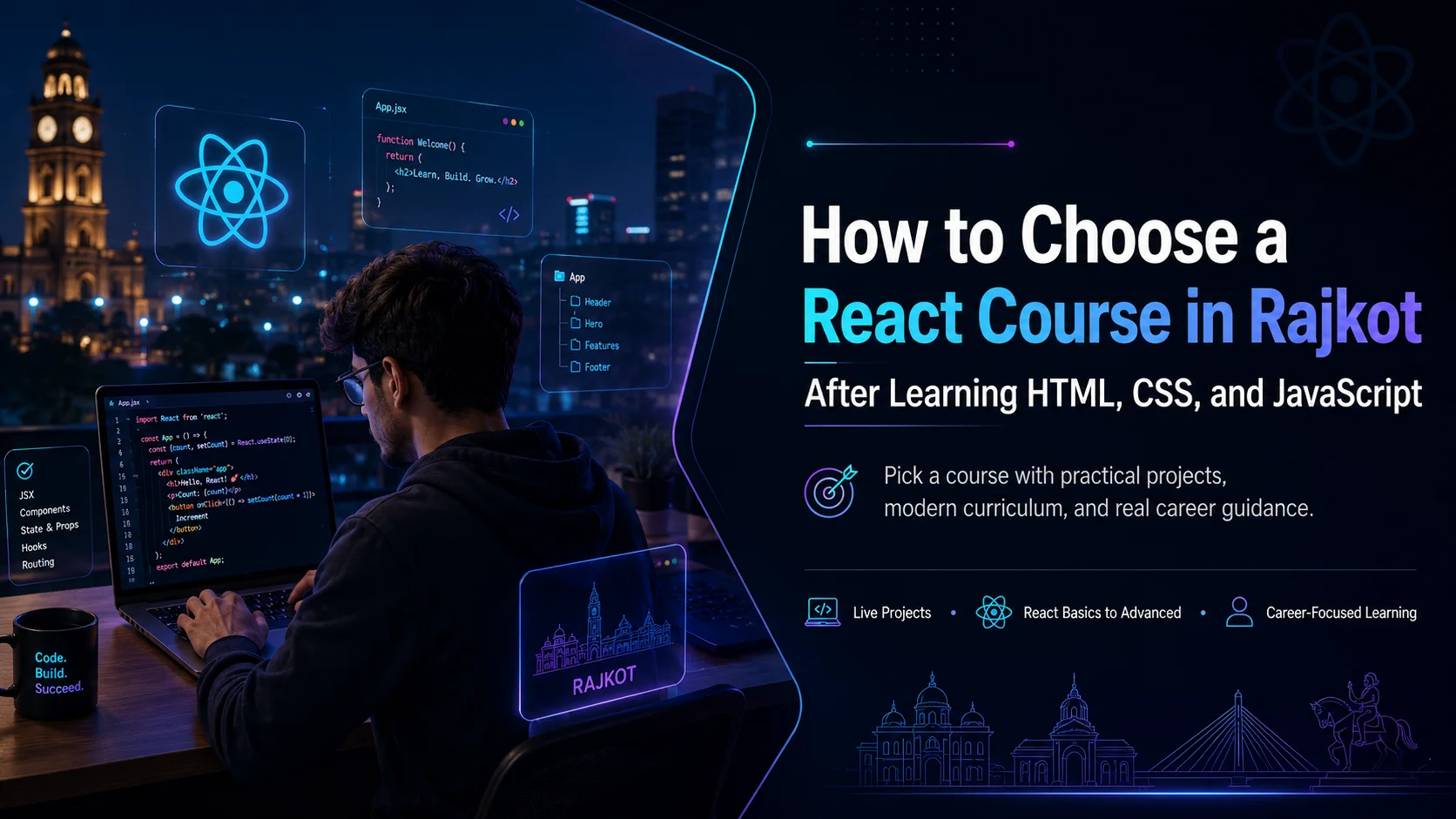
Quick Answer
When should you join a React course in Rajkot?
The right time is after you are comfortable with HTML, CSS, basic JavaScript, and browser fundamentals. A strong React course should then help you move from components and state into routing, API integration, project architecture, and modern tools such as Next.js.
Key Takeaways
Do not rush into React before your JavaScript basics are usable.
A good React course should cover components, hooks, routing, and API-driven projects.
Next.js exposure is a plus because it reflects modern React workflows.
Portfolio-quality frontend projects matter more than tutorial completion.
Many students in Rajkot reach the same point in their learning journey: they know HTML, CSS, and basic JavaScript, but they are unsure when to move into React. The answer is simple. Start React when you can already build small interfaces without depending on copy-paste code for every step.
1. React works best when your JavaScript basics are already stable
React adds another layer of thinking through components, props, state, and reactivity. If JavaScript still feels shaky, React can feel harder than it needs to. The strongest learning experience happens when you already understand the language well enough to focus on architecture and UI behavior.
2. A good React course should move beyond isolated hook demos
Look for a program that teaches how React is used inside complete interfaces. That means reusable component structure, routing, API integration, forms, state flow, and responsive design. Small toy examples are fine early on, but they should lead into larger product-style projects.
3. Next.js exposure is a strong signal of modern relevance
React alone is still useful, but modern frontend teams increasingly work with frameworks and production patterns that go beyond a simple client-only setup. If a course introduces Next.js in a practical way, that usually means the learning path is closer to current frontend workflows.
4. Your portfolio should prove more than visual polish
Good React projects show interaction design, component reuse, data flow, and integration with real APIs. Search for training that helps you build applications employers can evaluate instead of only attractive static screens.
5. In Rajkot, compare mentor depth and review quality
If you are comparing React courses locally, ask how code is reviewed, whether debugging is taught actively, and how students are guided through architecture decisions. Frontend growth speeds up when mentors help you understand why a pattern works, not just where to type it.
Related Reads
Frequently Asked Questions
Can I start a React course in Rajkot without JavaScript?+-
What should a practical React course include?+-
Is learning Next.js important after React?+-
AI Answers
Answer-focused summary for AI and local search
This section turns the article into short, citation-friendly answers that connect the topic back to Rajkot training intent.
When should you join a React course in Rajkot?+-
The right time is after you are comfortable with HTML, CSS, basic JavaScript, and browser fundamentals. A strong React course should then help you move from components and state into routing, API integration, project architecture, and modern tools such as Next.js.
How does this topic connect to local IT training in Rajkot?+-
This article supports students comparing Codegrin IT Academy, coding classes in Rajkot, and practical course options by turning the topic into a clear learning or career decision.
Related Resources
Related courses, blogs, and guides
These internal links connect this article with the most relevant learning paths and supporting resources.
Modern Frontend Development with React
Master React hooks, state management, and modern component architecture to build blazing-fast, interactive web frontends.
Full Stack Development with MERN
Master MongoDB, Express.js, React, and Node.js to build fast, robust, and full-featured enterprise web applications.
Building Scalable Apps with Next.js
Learn server-side rendering, static site generation, and advanced React patterns using the powerful Next.js framework.
How to Choose the Best IT Training Academy in Rajkot
A practical local guide to comparing IT training academies in Rajkot based on teaching quality, projects, mentors, placement support, and career fit.
Top IT Courses in Rajkot for Beginners After 12th or Graduation
A beginner-focused guide to choosing the right IT course in Rajkot based on career path, learning curve, project work, and long-term job potential.
Why a Full Stack Development Course in Rajkot Is a Strong Career Start
A practical guide to evaluating full stack development courses in Rajkot based on stack choice, project depth, backend coverage, and career outcomes.
React vs Vue: Which Framework Should You Learn First?
A practical comparison of React and Vue for beginners, career switchers, and aspiring frontend developers deciding where to start.
Is a Coding Bootcamp Worth It? A Practical Decision Guide
An honest framework for deciding whether a coding bootcamp is worth the time, money, and opportunity cost for your situation.
MERN vs MEAN: Choosing the Right Full Stack Path
A decision guide for learners comparing the MERN and MEAN stacks based on learning curve, job alignment, and project goals.
Next Step
Turn frontend basics into real React projects
If you already know HTML, CSS, and JavaScript, the next step is learning how to build component-driven interfaces that look and behave like modern products.
Explore React Training