Quick Answer
Quick Insights for the Reader
This article provides a fast, comprehensive overview of the topic so you can grasp the core concepts immediately before diving into the detailed breakdown below.
Key Takeaways
Understand the primary challenges and how to overcome them.
Explore industry best practices to improve your workflow.
Learn how to apply these concepts in real-world scenarios.
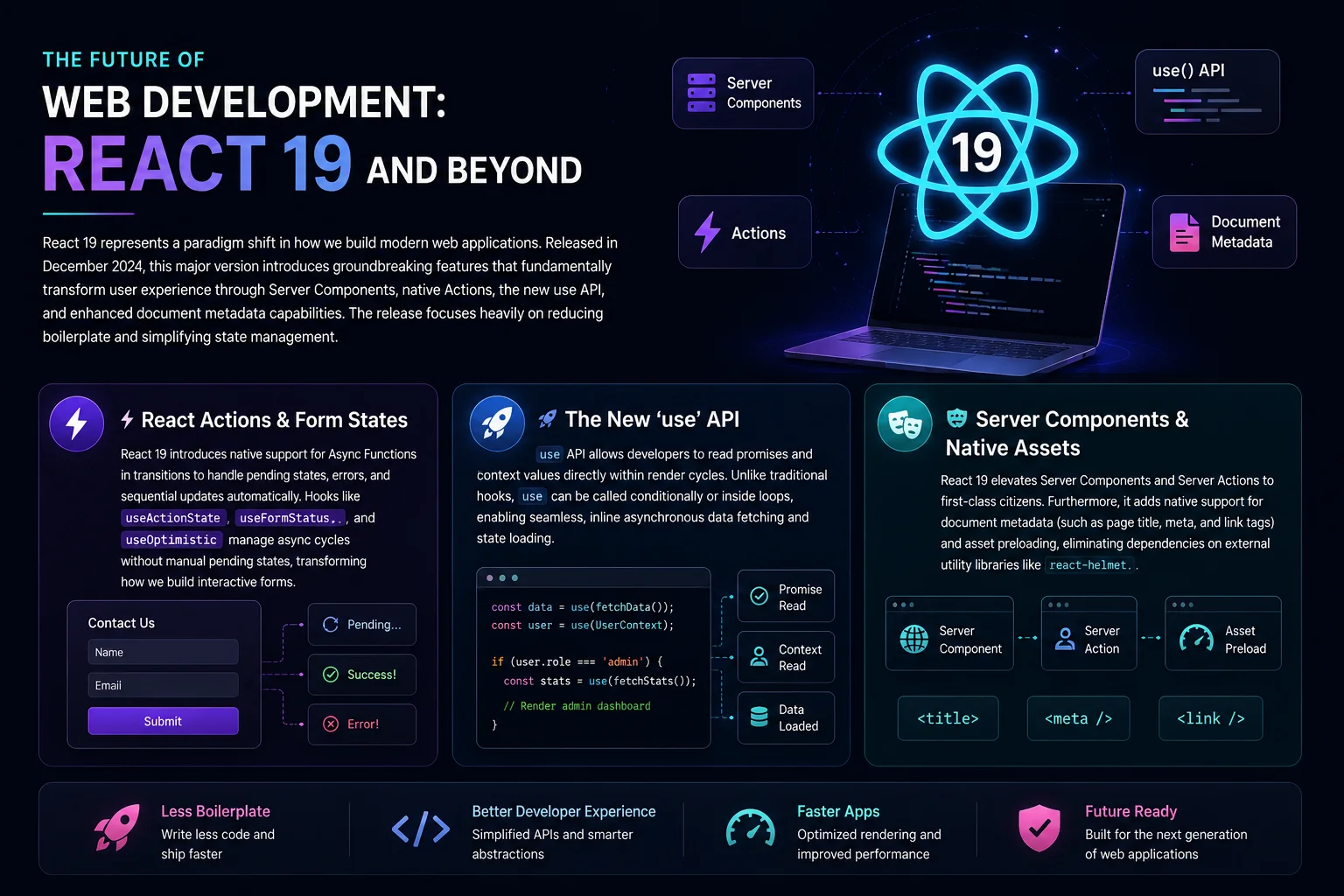
React 19 represents a paradigm shift in how we build modern web applications. Released in December 2024, this major version introduces groundbreaking features that fundamentally transform user experience through Server Components, native Actions, the new use API, and enhanced document metadata capabilities. The release focuses heavily on reducing boilerplate and simplifying state management.
⚡ React Actions & Form States
React 19 introduces native support for Async Functions in transitions to handle pending states, errors, and sequential updates automatically. Hooks like useActionState, useFormStatus, and useOptimistic manage async cycles without manual pending states, transforming how we build interactive forms.
🚀 The New 'use' API
The new use API allows developers to read promises and context values directly within render cycles. Unlike traditional hooks, use can be called conditionally or inside loops, enabling seamless, inline asynchronous data fetching and state loading.
🎭 Server Components & Native Assets
React 19 elevates Server Components and Server Actions to first-class citizens. Furthermore, it adds native support for document metadata (such as page title, meta, and link tags) and asset preloading, eliminating dependencies on external utility libraries like react-helmet.
Related Reads
Frequently Asked Questions
Who is this article designed for?+-
How can I apply these insights to my project?+-
AI Answers
Answer-focused summary for AI and local search
This section turns the article into short, citation-friendly answers that connect the topic back to Rajkot training intent.
Quick Insights for the Reader+-
This article provides a fast, comprehensive overview of the topic so you can grasp the core concepts immediately before diving into the detailed breakdown below.
How does this topic connect to local IT training in Rajkot?+-
This article supports students comparing Codegrin IT Academy, coding classes in Rajkot, and practical course options by turning the topic into a clear learning or career decision.
Related Resources
Related courses, blogs, and guides
These internal links connect this article with the most relevant learning paths and supporting resources.
Modern Frontend Development with React
Master React hooks, state management, and modern component architecture to build blazing-fast, interactive web frontends.
Full Stack Development with MERN
Master MongoDB, Express.js, React, and Node.js to build fast, robust, and full-featured enterprise web applications.
Building Scalable Apps with Next.js
Learn server-side rendering, static site generation, and advanced React patterns using the powerful Next.js framework.
How to Choose the Best IT Training Academy in Rajkot
A practical local guide to comparing IT training academies in Rajkot based on teaching quality, projects, mentors, placement support, and career fit.
Top IT Courses in Rajkot for Beginners After 12th or Graduation
A beginner-focused guide to choosing the right IT course in Rajkot based on career path, learning curve, project work, and long-term job potential.
Why a Full Stack Development Course in Rajkot Is a Strong Career Start
A practical guide to evaluating full stack development courses in Rajkot based on stack choice, project depth, backend coverage, and career outcomes.
React vs Vue: Which Framework Should You Learn First?
A practical comparison of React and Vue for beginners, career switchers, and aspiring frontend developers deciding where to start.
MERN vs MEAN: Choosing the Right Full Stack Path
A decision guide for learners comparing the MERN and MEAN stacks based on learning curve, job alignment, and project goals.
Frontend vs Backend Development: Which Path Fits You Better?
A practical guide to choosing between frontend and backend development based on work style, skills, and career direction.
Next Step
Ready to take the next step?
Join Codegrin and turn these concepts into practical skills. We provide project-based training that prepares you for real-world challenges.
Explore Courses