Quick Answer
Quick Insights for the Reader
This article provides a fast, comprehensive overview of the topic so you can grasp the core concepts immediately before diving into the detailed breakdown below.
Key Takeaways
Understand the primary challenges and how to overcome them.
Explore industry best practices to improve your workflow.
Learn how to apply these concepts in real-world scenarios.
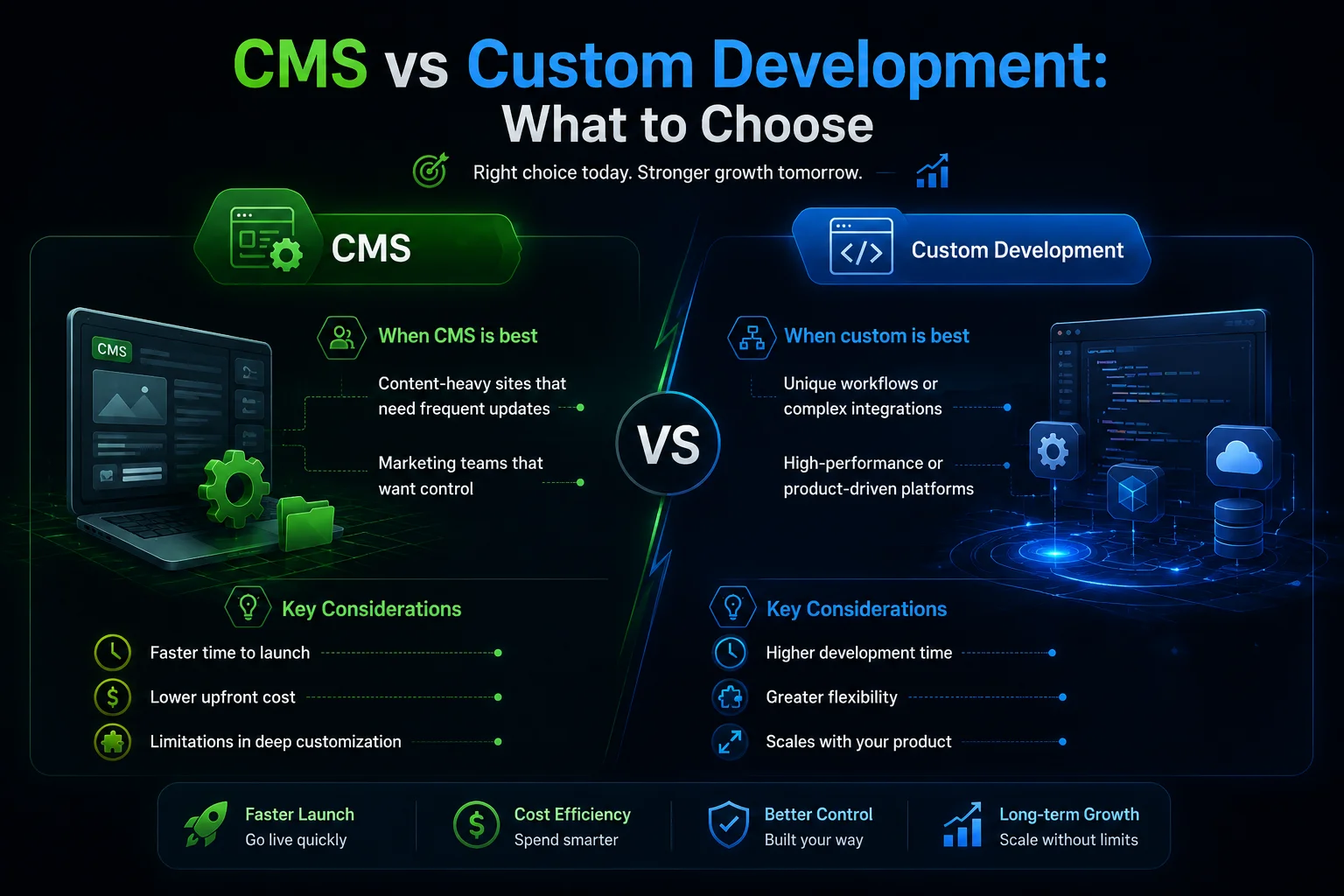
When starting a new website project, business leaders face a key technical decision: should we build on a Content Management System (CMS like WordPress or Webflow) or opt for a Custom Web Application? Both approaches have distinct advantages.
📦 Content Management Systems (CMS)
CMS platforms allow users to create, manage, and modify website content without writing code.
- Pros: Fast initial setup, easy content updates for non-technical staff, and lower initial development costs.
- Cons: Restricted custom functionality, dependencies on plugins, and potential performance overhead.
💻 Custom Web Development
Custom development involves building a tailored solution from scratch using frameworks like React, Next.js, or Vue.
- Pros: Infinite flexibility, ultimate page loading speed, high security, and clean, scale-ready codebases.
- Cons: Higher upfront investment, longer development timelines, and requires developer expertise to modify core layouts.
📋 The Verdict
Choose a CMS for marketing sites, standard blogs, and business websites where rapid changes and self-editing are priorities. Choose Custom Development for unique SaaS platforms, complex database portals, and performance-first web tools that require high scalability.
Related Reads
Frequently Asked Questions
Who is this article designed for?+-
How can I apply these insights to my project?+-
AI Answers
Answer-focused summary for AI and local search
This section turns the article into short, citation-friendly answers that connect the topic back to Rajkot training intent.
Quick Insights for the Reader+-
This article provides a fast, comprehensive overview of the topic so you can grasp the core concepts immediately before diving into the detailed breakdown below.
How does this topic connect to local IT training in Rajkot?+-
This article supports students comparing Codegrin IT Academy, coding classes in Rajkot, and practical course options by turning the topic into a clear learning or career decision.
Related Resources
Related courses, blogs, and guides
These internal links connect this article with the most relevant learning paths and supporting resources.
Modern Frontend Development with React
Master React hooks, state management, and modern component architecture to build blazing-fast, interactive web frontends.
Full Stack Development with MERN
Master MongoDB, Express.js, React, and Node.js to build fast, robust, and full-featured enterprise web applications.
Building Scalable Apps with Next.js
Learn server-side rendering, static site generation, and advanced React patterns using the powerful Next.js framework.
How to Choose the Best IT Training Academy in Rajkot
A practical local guide to comparing IT training academies in Rajkot based on teaching quality, projects, mentors, placement support, and career fit.
Top IT Courses in Rajkot for Beginners After 12th or Graduation
A beginner-focused guide to choosing the right IT course in Rajkot based on career path, learning curve, project work, and long-term job potential.
Why a Full Stack Development Course in Rajkot Is a Strong Career Start
A practical guide to evaluating full stack development courses in Rajkot based on stack choice, project depth, backend coverage, and career outcomes.
React vs Vue: Which Framework Should You Learn First?
A practical comparison of React and Vue for beginners, career switchers, and aspiring frontend developers deciding where to start.
Is a Coding Bootcamp Worth It? A Practical Decision Guide
An honest framework for deciding whether a coding bootcamp is worth the time, money, and opportunity cost for your situation.
MERN vs MEAN: Choosing the Right Full Stack Path
A decision guide for learners comparing the MERN and MEAN stacks based on learning curve, job alignment, and project goals.
Next Step
Ready to take the next step?
Join Codegrin and turn these concepts into practical skills. We provide project-based training that prepares you for real-world challenges.
Explore Courses